


RTS25
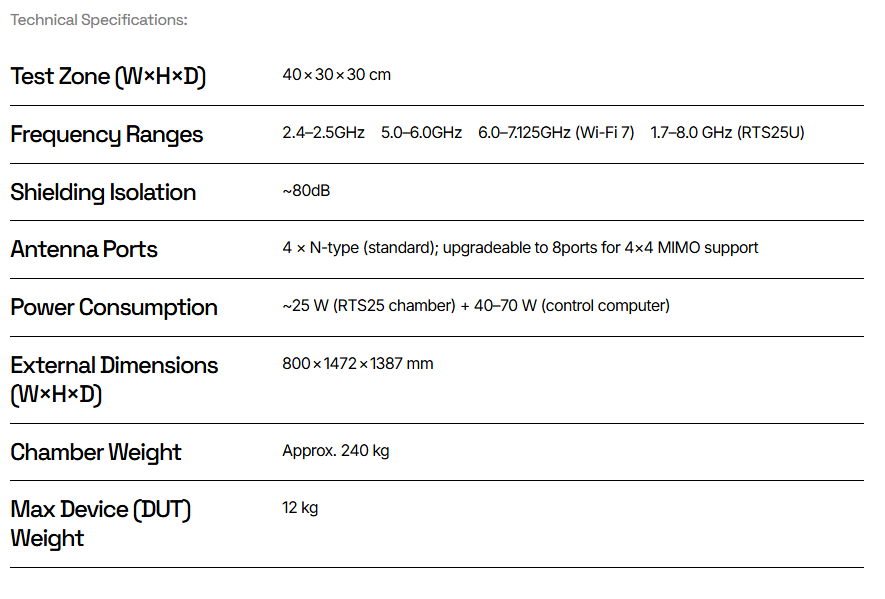
- 1.7 GHz – 8 GHz (RTS25U model)
- Reverberation chamber (RIMP)
- Max DUT size: 40 × 30 × 30 cm
- 4 active antenna ports (8 optional)
- TRP / TIS / Throughput OTA
- Bluetest Flow platform
RTS25 is the most compact reverberation test system in the RTS family, optimized for WLAN, Bluetooth and IoT OTA measurements in a shielded, repeatable, and accurate multipath environment. It provides a generous 40 × 30 × 30 cm test zone for small devices and supports 2.4 GHz, 5 GHz, and 6.0–7.125 GHz band (Wi-Fi 6E/7). The recently introduced RTS25U model supports an unbanded frequency range from 1.7 to 8 GHz.
RTS25 – A Scaled-Down Test System
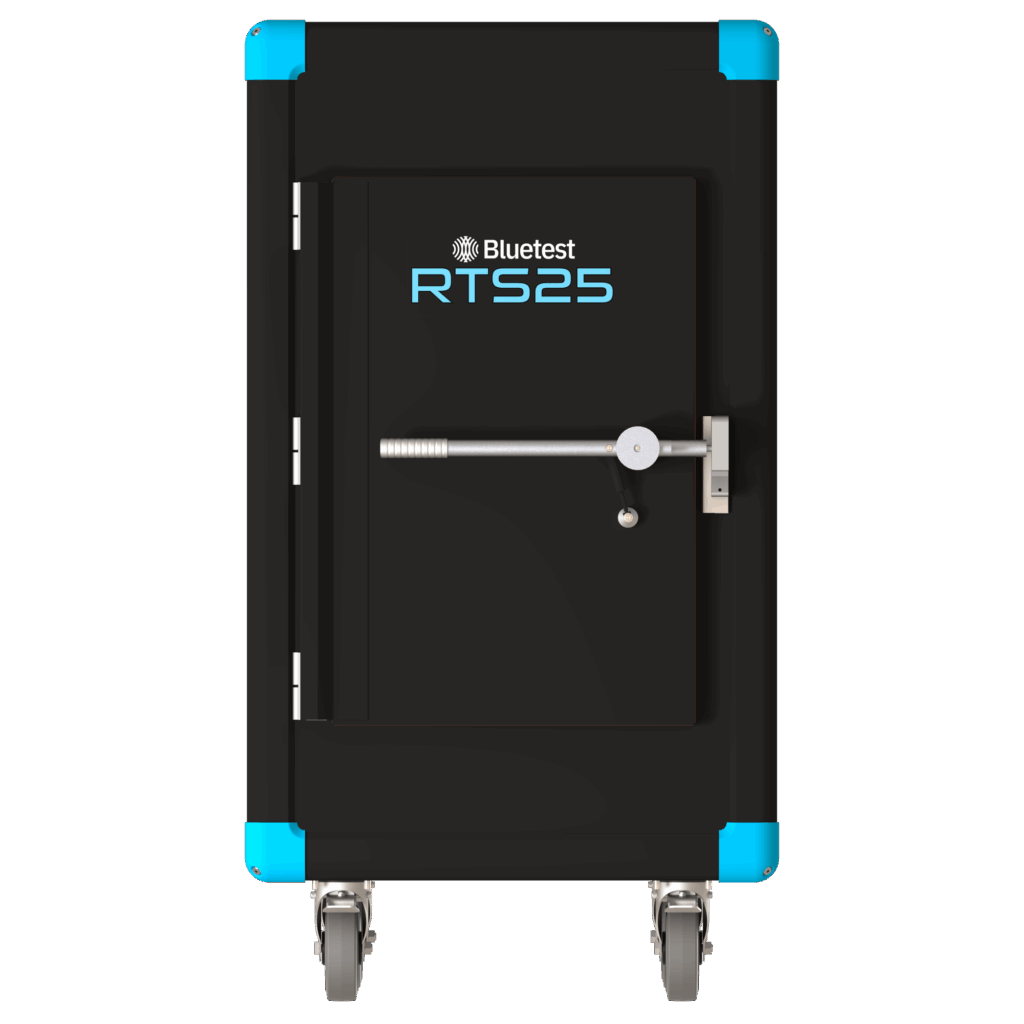
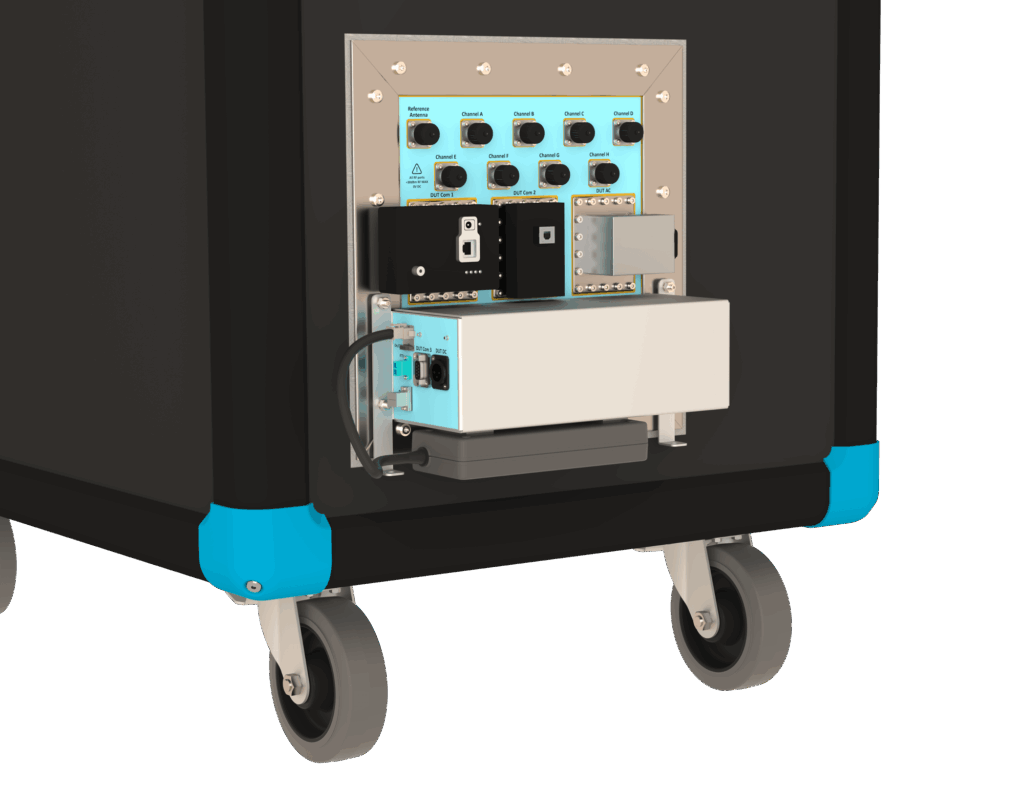
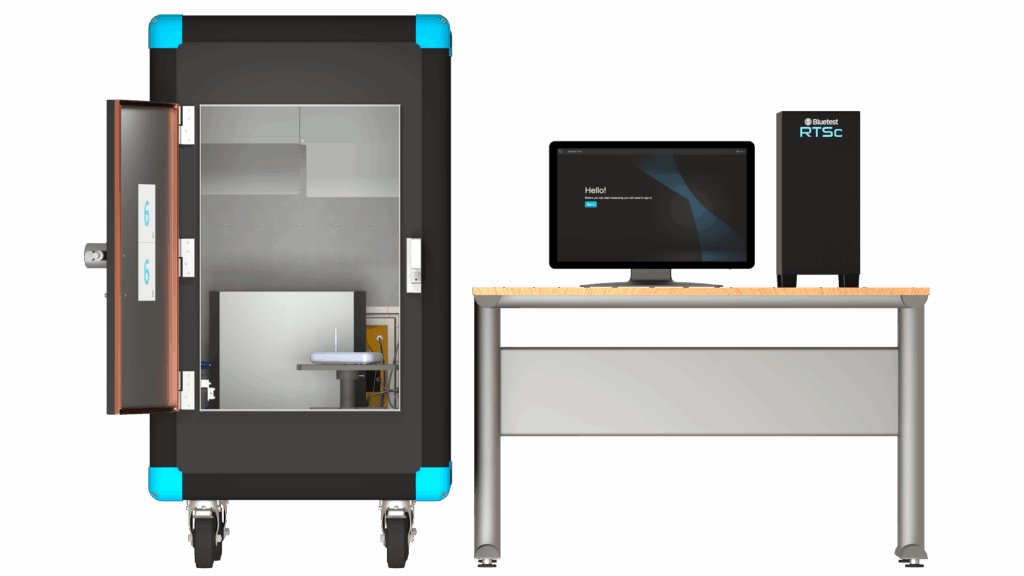
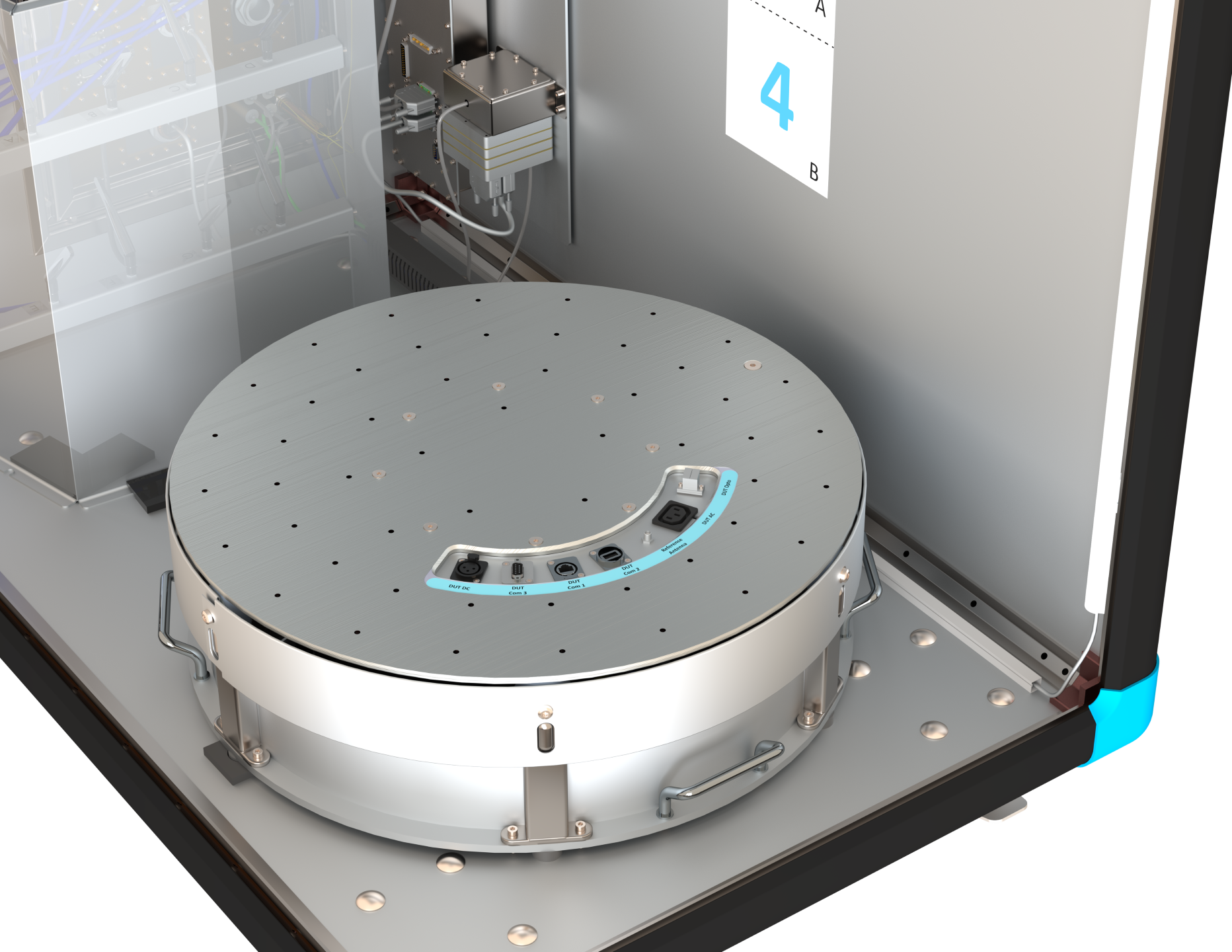
RTS25 is the smallest system in the RTS family, built to help engineers verify and compare wireless OTA performance in a shielded, repeatable, and accurate multipath environment. It solves the common OTA problem of “inconsistent test conditions” by providing a controlled RIMP chamber (Rayleigh-faded, rich isotropic multipath) generated by the reflective interior, DUT turntable, and rotating mode stirrers, and it’s enabled by default without requiring external multipath equipment such as channel emulators.
RTS25 is optimized for Bluetooth, WLAN, and other IoT standards operating in the 2.4 GHz and 5 GHz ISM bands, plus the 6.0–7.125 GHz band introduced by Wi-Fi 6E (and used for Wi-Fi 7 as well). For applications that need broader frequency coverage, the RTS25U extends the same platform down to 1.7 GHz and up to 8.0 GHz, adding support for the LTE and 5G NR bands within that range. This makes RTS25U well suited to multi-radio devices such as smartphones, connected automotive modules, and IoT gateways, where verification across cellular and short-range standards would otherwise require separate test setups.
Despite the compact footprint, both systems are designed to accommodate a broad range of small devices (think access points, laptops, speakers, medical aids, and smart home products) within the available test zone.
With RTS25 you can run essential OTA measurements to characterize device performance, including:
- TRP (how strong the transmitter + antenna design is)
- TIS (receiver sensitivity by stepping signal power down until loss of signal)
- Data throughput (data rate vs signal power, showing drop-offs and disconnect behavior)
Because the chamber provides the multipath conditions automatically, results are repeatable and representative of real-world usage, including the conditions needed to evaluate MIMO and diversity behavior.
RTS25 is also built for MIMO: the reverberation chamber inherently provides the multipath MIMO requires, without expensive add-ons. Up to 4×4 MIMO is included as standard and can be measured as easily as SISO, making RTS25 suitable for WLAN testing such as 802.11be. The system uses four measurement antennas, with an optional upgrade to eight measurement antennas for higher MIMO order, connecting multiple instruments, and enabling co-existence/de-sense/interference testing (e.g. WLAN performance with a Bluetooth interferer, or Bluetooth with another Bluetooth interferer).
For a complete WLAN throughput setup, Bluetest can add:
- ISS11 Attenuator: controls path loss with an external access point/device. It supports WLAN up to 4×4 MIMO including Wi-Fi 7 (limited by the connected AP), includes calibration info for accurate measurements across the supported bands, and can be used for other standards like 802.11p and IoT.
- TRU2 WLAN Reference Unit: tri-band reference radio that operates as AP and client, enabling uplink and downlink throughput measurements, supporting 802.11ax (4×4 MIMO) and legacy WLAN (802.11a/b/g/n/ac).
- TTS3 WLAN Throughput Test System: tri-band reference radio with integrated step attenutors to control the loss in each band. Supports 802.11be, 4×4 MIMO, MLO/MRU, AP and client mode, uplink and downlink throughput measurements, and legacy WLAN standards (802.11a/b/g/n/ac/ax).
RTS25 and RTS25U ship fully assembled, fit into office environments and existing labs without major room changes, and are controlled by the Bluetest Flow platform: Flow Manager (remote configuration), Flow Touch (browser-based monitoring/control on the included touchscreen or any device), and Flow Analyzer (database-backed search, tagging, comparisons, exports, and HTML reports). Calibration can be done in under 15 minutes using your own VNA, or via an off-site calibration service with predefined files. DUT interfacing supports multiple power and communication options, including AC/DC, Ethernet (1/2.5/5/10 Gb), USB, and RS-232, including Bluetooth 4/5 HCI support. Training, upgrades, and maintenance plans keep the system aligned with evolving wireless technologies.